New Delhi/Port Blair: Located at the far eastern edge of the Andaman and Nicobar Islands archipelago, Barren Island is India’s only active volcano. This island has been a mysterious attraction not only for geologists but also for adventure tourists. This massive cone rising from serene waters has remained in the news due to its activities and unique ecosystem. The story of this island is not just one of fire and ash; it is an incredible tale of the Earth’s inner secrets and nature’s remarkable resilience.
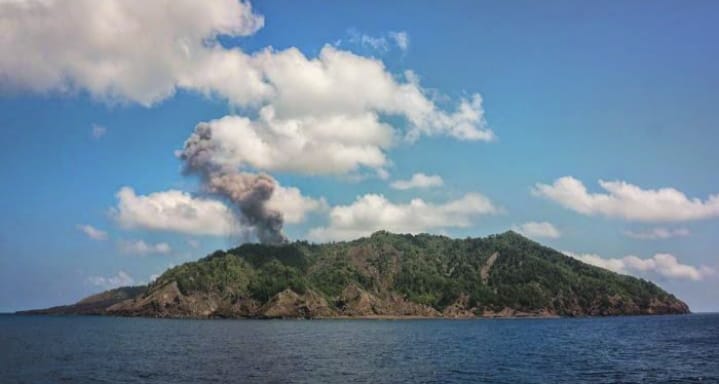
- Barren Island: A Geological Marvel
Barren Island is located approximately 138 km northeast of Port Blair. Its very name reflects its isolated and barren nature.
Part of the Asian Volcanic Arc
· Geological Origin: This volcano is part of the volcanic arc stretching from Indonesia to Myanmar. The collision (subduction) of the Indian and Burmese plates causes ongoing geological activity in this region.
· Type: It is a Stratovolcano, formed by layers of lava, ash, and volcanic rocks.
· Volcanic History:
· First Recorded Eruption: Occurred in 1787, after which it erupted multiple times in the 18th and 19th centuries.
· Modern Activity: A major eruption occurred in 1991, after which it became active again. News of its eruption also emerged in 2017, confirming its continued activity.
· Current Status: Currently, the volcano continues to emit gases, smoke, and occasionally slow lava flows, indicating its internal heat.
- Ecology: The Balance of Life and Destruction
Contrary to its name, Barren Island is not entirely barren. The volcanic soil, rich in minerals, gives rise to a unique and hardy adapted ecosystem.
Flora and Fauna
· Flora: Some shrubs and grasses grow on the outer edges of the island, capable of withstanding high temperatures and volcanic gases.
· Mammals: Primarily wild goats are found here, which were once domestic but have become feral, adapting to lava flows and the harsh climate. These goats are an interesting subject of study for geologists on how life thrives even in extreme conditions.
· Marine Life: The waters surrounding the island are rich with marine life. The rocks and warm water attract certain unique species.
· Coral Reefs: Although affected by volcanic ash, unique Black Coral is found here.
· Fish and Sharks: Despite the warm water, diverse types of fish and reef sharks are often seen.
- Safety and Scientific Study
Being an active volcano, Barren Island is under scientific surveillance, and strict rules apply for tourist access.
Continuous Monitoring and Research
· GSI’s Role: The Geological Survey of India (GSI) regularly monitors the volcano’s activities. Sensors have been installed to measure seismic activity, gas emissions, and ground deformation.
· International Collaboration: Several international volcanology organizations analyze data in collaboration with Indian scientists.
· Prediction Efforts: Scientists are trying to understand how and when India’s only active volcano will behave, to guard against any potential danger.
Tourism Regulations
· Landing Prohibited: Landing on the island is strictly prohibited. This is not only due to the danger from the volcano but also to protect its fragile ecology.
· Tourism Experience: Tourists can only observe the island from a safe distance via boats or ships.
- Mystery and Myths
This isolated and powerful island is associated with some local legends and mysteries.
Place in Local Culture
· Meaning of the Name: There is less direct mention of this island in the local language, but its isolated location makes it a mysterious center of power.
· Sailors’ Experiences: For centuries, sailors passing by have seen smoke and flames, making the island a part of their folklore.
- Future Possibilities
Barren Island is like Earth’s laboratory, where we can observe geological processes in ‘real-time’.
Geothermal Energy Potential
· Energy Source: There is a vast amount of geothermal energy present in this region.
· Challenges: However, harnessing this energy is a major challenge due to the island’s remoteness, active nature, and ecological sensitivity.
Impact of Climate Change
· Sea Level: Studying Barren Island could also help scientists understand the impact of rising sea levels on volcanic and tectonic activities.
Conclusion
Barren Island is not just an island or a volcano; it is a living geological monument that reminds us of our Earth’s immense power and constant state of flux. It showcases two opposing facets of nature – destructive power and the resurgence of life – simultaneously.